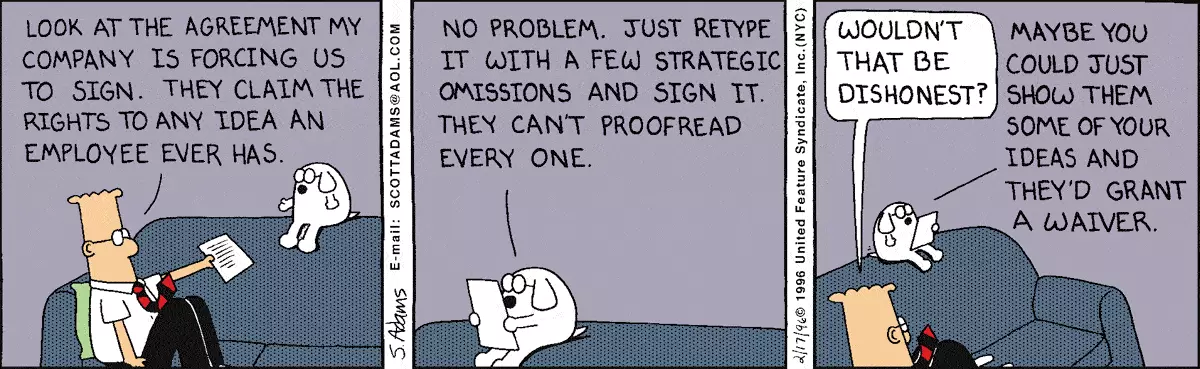
Dilbert cartoon first published on Saturday 17th February 1996
Dilbert//2499, first published thirty years ago on Saturday 17th February 1996
Tags
agreement grant sign strategic omissions waiver proofread company forcing to sign business
Official transcript
Dilbert sits on the couch with his knees bent. He hands a document to Dogbert and says, "Look at the agreement my company is forcing us to sign. They claim the rights to any idea an employee ever has."
Dilbert looks at the document and says, "No problem. Just retype it with a few strategic omissions and sign it. They can't proofread every one."
Dilbert asks, "Wouldn't that be dishonest?"
Dogbert replies, "Maybe you could just show them some of your ideas and they'd grant a waiver."
originally published on dilbert.com
Open source transcript
LOOK AT THE AGREEMENT MY COMPANY IS FORCING US TO SIGN. THEY CLAIM THE RIGHTS TO ANY IDEA AN EMPLOYEE EVER HAS.
NO PROBLEM. JUST RETYPE IT WITH A FEW STRATEGIC OMISSIONS AND SIGN IT.
THEY CAN'T PROOFREAD EVERY ONE.
WOULDN'T THAT BE DISHONEST?
MAYBE YOU COULD JUST SHOW THEM SOME OF YOUR IDEAS AND THEY'D GRANT A WAIVER.
collated from github.com/jvarn/dilbert-archive
AI Analysis
The comic strip is titled "Dishonesty in the Workplace" and features Dilbert, a character known for his sarcastic wit and observations about corporate culture.
The Comic Strip's Content
- The strip depicts a meeting where an employee is forced to sign a contract that claims the company has the rights to any ideas an employee may have.
- The employee is hesitant to sign, citing concerns about the company's intentions and the potential for misuse of their ideas.
- The boss responds by asking if the employee would be dishonest if they were to show some of their ideas and then grant a waiver.
- The employee is left feeling uncomfortable and unsure about what to do.
The Strip's Commentary
- The comic strip comments on the lack of trust and transparency in the workplace, where employees are often expected to surrender their creative rights without clear benefits or compensation.
- It highlights the power imbalance between employees and management, where employees may feel pressured to sign agreements that are not in their best interests.
- The strip also touches on the theme of dishonesty, suggesting that even if employees are not being outright dishonest, they may still be engaging in behaviors that are not entirely truthful or transparent.
Overall
- The comic strip is a humorous commentary on the challenges of navigating the corporate world and the importance of maintaining one's integrity and autonomy in the face of bureaucratic red tape.
generated by llama-3.2-11b-vision-instruct
Accompanying textual content, such as title, tags and transcripts, is shown here if we have it. Not every comic has all of these, and they seem to be a bit hit and miss even on the official website.